Why vibe coding platforms pay too much for backends
January 23, 2026
8
minute read

Tomas Halgas
Founder & CEO

Running a vibe coding platform often feels deceptively cheap at first.
Models are fast, first generations look impressive, and early users can ship something tangible within minutes. From the outside, it can seem like inference costs will stay manageable as long as prompts are short and models are chosen carefully.
In practice, that intuition breaks down quickly.
At scale, the dominant cost driver for many vibe-coding platforms is not UI generation, copy, or even general reasoning. It is backends - both the cost of generating them and, even more importantly, the cost of hosting them once they exist.
This article looks at both sides of that problem, with concrete numbers, and explains why changing the backend abstraction itself has a much larger impact on platform economics than model choice or prompt optimization.
Where the money actually goes
Most vibe-coding platforms can roughly group their costs into three buckets:
frontend and UI generation
backend generation
backend hosting
What changes at scale is not the cost of any single generation, but how often backend work repeats and how long backends stick around.
A typical user might generate UI once and tweak it lightly. Backends behave differently. Users generate a backend, then iterate on it - adding fields, permissions, workflows, fixing edge cases, and refining behavior.
(Even when agents apply incremental edits rather than rebuilding everything from scratch, backend iteration still requires repeated global rereads and large code re-emissions, which dominate cost.)
Many of these backends are then deployed, left running, and only sporadically used - or abandoned entirely. That combination is what bends the cost curve.
Backend generation: cheap once, expensive repeatedly
It is entirely realistic for a platform to generate:
a TypeScript backend in 5–10 minutes, or
a declarative backend definition in 2–3 minutes using a language like SLang.
From a token perspective, both are cheap. With current fast models, a first runnable backend typically costs $0.01–$0.10. With stronger reasoning models, it may be $0.10–$0.50. Declarative backends are usually somewhat cheaper even at this stage because they emit significantly less code.
That first version, however, is not what platforms pay for.
Platforms pay for every iteration that follows, and iteration costs are not linear.
Modern APIs price output tokens several times higher than input tokens. Cost is therefore driven primarily by how much code the model emits per iteration, and how many times it must re-emit it.
In a typical TypeScript backend, structure is implicit and scattered across schemas, migrations, DTOs, services, routes, auth middleware, workers, and tests. A small conceptual change - for example, introducing organization ownership - forces the model to reread a large context and re-emit a large amount of glue code, often across several generate-and-fix loops.
In a declarative backend, the same change is expressed once. The model emits fewer tokens per iteration, and retries are rarer because there is less surface area for inconsistency.
Generation cost by backend maturity
The table below shows typical cumulative generation cost per backend, including automated iterate-and-fix loops. Models are grouped into two buckets most platforms already use.
Approximate generation cost per backend (USD)
Backend stage | Declarative backend (SLang) | TypeScript backend |
|---|---|---|
Fast models | ||
First runnable | $0.005–$0.05 | $0.01–$0.10 |
Demo-quality | $0.05–$0.50 | $0.10–$1.00 |
Shippable MVP | $0.10–$0.50 | $0.50–$2.00+ |
Production-grade | $0.50–$1.50 | $2.00–$5.00+ |
Strong models | ||
First runnable | $0.05–$0.25 | $0.10–$0.50 |
Demo-quality | $0.50–$2.00 | $1.00–$4.00 |
Shippable MVP | $1.00–$3.00 | $3.00–$15.00+ |
Production-grade | $3.00–$10.00 | $10.00–$40.00+ |
Individually, these numbers don’t look dramatic. They become dramatic when multiplied by thousands of users, several iterations per user, and large numbers of abandoned sessions that still incurred full cost.
But even this is only half the story.
Hosting: where costs quietly dominate
Generation costs are bursty. Hosting costs are continuous.
A naïve approach - one backend per app, one database per backend, always on - is workable for a handful of apps and catastrophic at platform scale. Even very small backends often cost $25–$95 per month to host when provisioned conservatively, dominated by managed database minimums and idle compute.
The more important question is therefore not “how cheap can we host a backend?”, but:
How close can we get to the theoretical minimum required by the actual workload?
The theoretical hosting floor
If you strip away per-app fixed overhead and look only at raw work - data transferred, CPU time, and durable storage - the numbers are surprisingly low.
Using conservative assumptions, the work-based lower bound for hosting looks roughly like this, compared to what a platform can achieve with common optimizations or a highly optimized framework like Sutro:
Approximate backend hosting cost per app / month (USD)
App type | Theoretical minimum(work-based floor) | Highly standardized zero-infra backend (Sutro-style) | Well-optimized vibe-coding platform | Naïve per-app stack(1 app = 1 DB + always-on compute) |
|---|---|---|---|---|
Tail-end app (mostly idle) | ~$0.015 | ~$0.05–$0.15 | ~$0.30–$1.00 | ~$25–$80 |
Active MVP app | ~$0.25 | ~$0.40–$0.80 | ~$1.50–$3.00 | ~$25–$80 |
Heavy-use app | ~$5.00 | ~$6–$8 | ~$10–$20 | $50+ |
The theoretical minimum reflects irreducible costs: bandwidth, CPU, and durable storage. No real platform hits this exactly, but it establishes a hard lower bound.
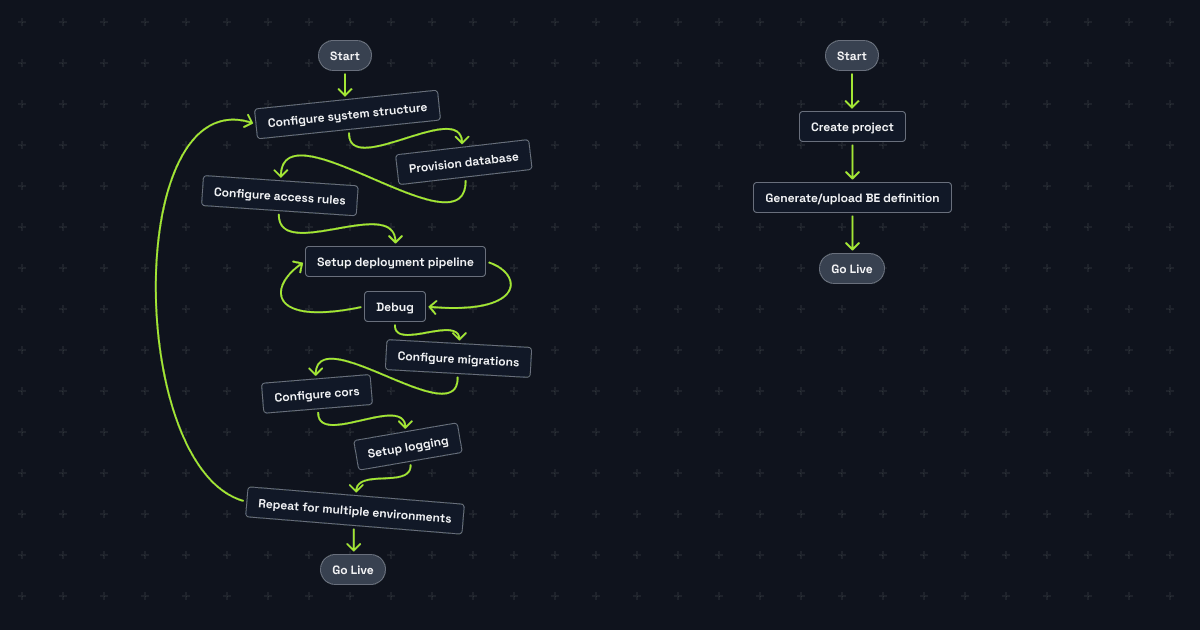
The closer a platform’s backend architecture is to a fully standardized, machine-understandable model, the closer it can approach that floor. Platforms built around ad-hoc backend code are forced to provision conservatively, which is why hosting costs remain orders of magnitude higher even when traffic is low.
Why standardisation is the limiting factor
Approaching the theoretical minimum requires:
safely hosting many backends on shared compute
safely hosting many apps in shared databases
putting idle backends to sleep and resuming them on demand
All three require strong, explicit guarantees about structure, isolation, and lifecycle.
With ad-hoc TypeScript backends, those guarantees are implicit and inconsistent. Infrastructure has to treat each backend as an opaque blob, which severely limits how aggressively it can optimise.
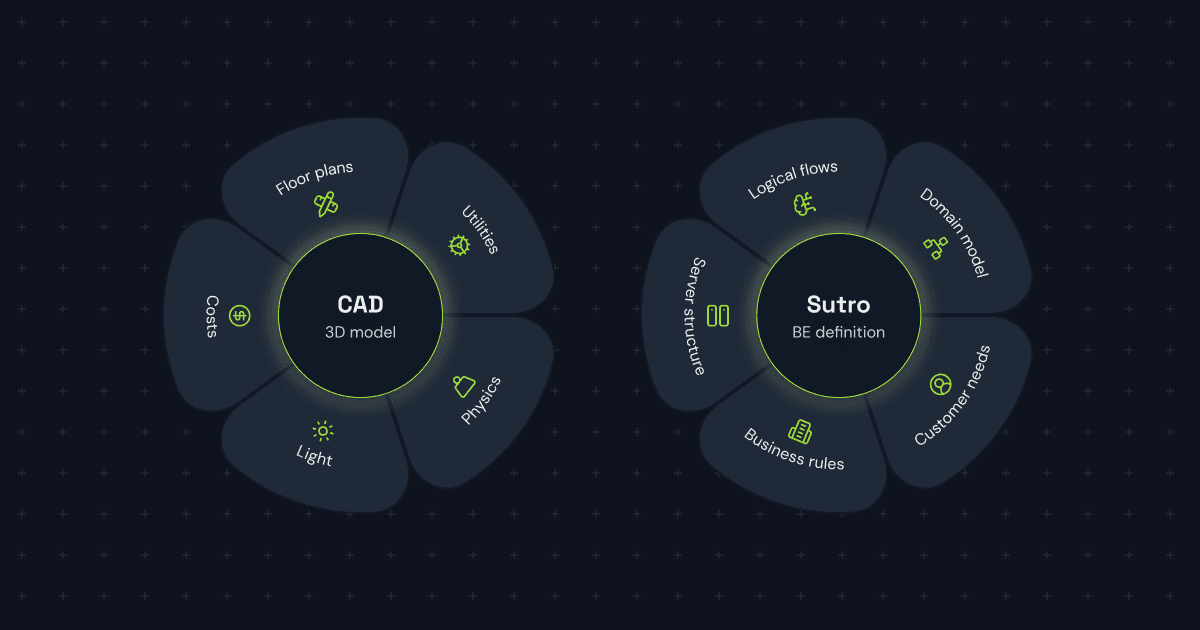
With a hyper-standardised backend definition - where entities, ownership, permissions, and workflows are explicit - these optimisations become routine rather than risky.
This is where backend language choice quietly determines both generation costs and long-term hosting economics.
Why this matters specifically for vibe-coding platforms
Vibe-coding platforms succeed by encouraging exploration and iteration. That makes them uniquely exposed to backend costs:
backends are iterated on frequently
many apps are deployed briefly and then abandoned
most backends are small, idle, and structurally similar
In that environment, backend generation and hosting are not edge cases. They are the dominant cost center.
The question is not whether AI can generate a backend. It clearly can.
The question is whether a platform can afford what happens after the third, fifth, or tenth iteration - and whether it can host thousands of small apps without paying per-app fixed costs forever.
Changing models helps at the margins. Changing the backend abstraction changes the curve.
That is the problem Sutro is designed to solve.
Want numbers for your platform?
All figures above are conservative, order-of-magnitude estimates based on our research and internal testing. Actual costs depend on your average backend size, how often users iterate, how much context you resend, and how you host generated apps.
If you want a calculation tailored to your platform’s real usage patterns, get in touch. We’re happy to run the numbers with you and show exactly where the biggest savings come from in your specific setup.
That’s where the difference becomes impossible to ignore.